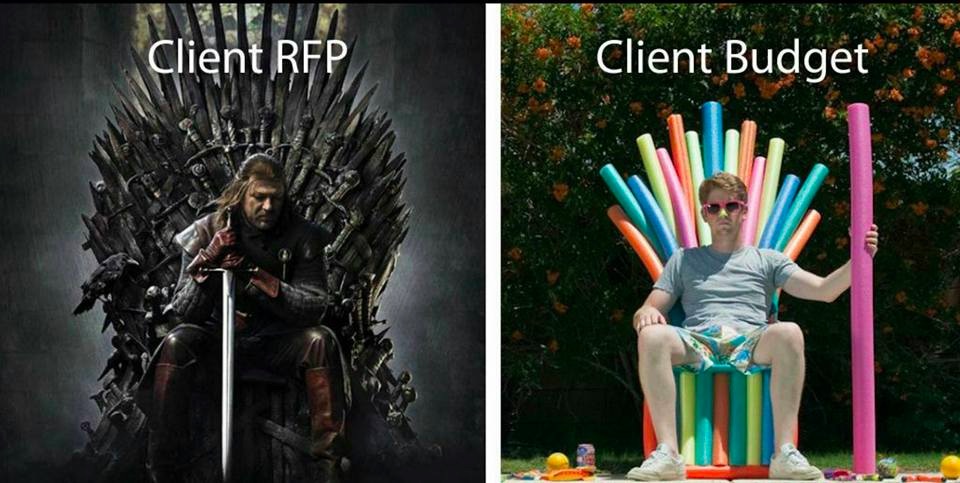
As I find myself in RFP-land again, I found myself pondering how my previous startups spent tremendous amounts of time working on these Requests For Proposals from huge customers. Enough so to warrant a blog post that may be helpful for current startups: how to choose between small customers and large customers, like governments and telcos with procurement departments.
Now, there are of course rare startups that sell straight to consumers, and their game is different. These typically are the startups everyone knows about, because they deal with customers (you) directly. But chances are your startup either sells to businesses, or will need to reach the consumer through established distributors or vendors that embed your stuff into their product. If you plan to sell to consumers directly, this post is not for you.
For context, most startups eventually have a ‘minimum viable product’ (MVP), or at least something that strives to be that. Product/market fit has not been achieved, let alone a perfect match. In other words, customers may be wanting things you have not gotten round to offering, or did not know they wanted. And meanwhile you added lots of stuff that the perceive as excess baggage. Not only is the product not perfect, neither is your knowledge of the market. There may not BE a market yet!
At this stage, there should be good contact with potential customers already. There are lots of small ones to talk to and far fewer very large ones. Who should you spend your time on?
Everyone discovers early that lofty revenue/profit goals will not be achieved with smaller customers in a reasonable timeframe. If you need thousands of business engagements to get to where you want to be, a startup-sized salesforce is not going to get you there in a reasonable timeframe. In fact, the salesforce that could make this happen does not want to work with you. Good salespeople work with companies with established products so they know they can make quotum (READ THIS LINK, by the way).
So when a potential ‘whale’ of a customer comes along, it is tempting to jump on that and give it all you got. And here is where I want to warn you. Large corporations and governments typically ‘tender’ deals. They don’t just pick a vendor, test their stuff, and make the deal. Instead, they write out a very confusing and conflicting list of requirements and instructions, and send that to any interested parties. Which may include you!
A typical RFP-process includes a spreadsheet filled with hundreds or thousands of numbered requirements, a set of documents outlining the procedure, and a number of questions like ‘outline security architecture of the product’, ‘provide copy of your sustainable sourcing policy’, and ‘describe in detail how the system deals with errors’. Next up might be a clarification meeting, where you can ask questions about the requirements and procedure. You then send in the huge stack of requested documents, after which you might be invited to present your company in person. This is then followed by interminable rounds of negotiations, references, proof of concept sessions etc.
Now, if your product is struggling to find a market (and at the beginning, it WILL be), this sure feels like traction! We’re getting somewhere, we have a potential customer, they have requirements, we can try to meet them, we have to show up for presentations etc. It almost feels like the real thing!
In my startups, I have wasted MONTHS on these processes. Turns out however, startups don’t win RFPs. Not until the word ‘startup’ starts feel wrong for your (by now) serious company.
Then, there is this
So why don’t you win an RFP as a small startup? For one, there is the kind of company that inflicts the RFP-process on itself. These are not dynamic places. These are not the organisations that want to give a startup a chance. That’s why they do an RFP, to make sure nothing is bought where they don’t have it in (credible) writing that the product will do what it promises. You mostly sell to the procurement department, not the actual user. And no matter how fab your product or service, the procurement department sees only risk in your startup. For one they will try to check your financials for the past three years. You have not HAD three years!
The second reason you don’t win is that an RFP is a compendium of every requirement someone ever voiced in the company. Hundreds of them at least. And this strongly favours incumbent vendors who have had years or decades to add every such feature under the sun, if it makes sense or not. The deck is stacked against you.
This third reason you don’t win an RFP is that is is typically heavily lobbied by existing relationships, making sure that only one vendor qualifies, or that new challengers (you) are immediately disqualified from the process because you don’t have 100 staff, over 10 million in annual revenue or 5 years of profitable business behind you.
In addition, the RFP process is highly depressing:
Seeing a list of features you don’t have and won’t have anytime soon is painful
Many requirements are in fact nonsense (‘system MUST be redundant against power failures’ - customer is trying to procure software!) - which makes you wonder about the state of the world
Finding out you didn’t actually have a chance because you are a startup is a blow
But the siren song of the RFP is still tempting for the business to business startup since it sure feels like progress and traction! It may be hard to resist if no other actual sales are going on. So, here are some reasons why it might make sense to participate in an RFP anyhow:
You get a free list of competitor features! Most of them show up as requirements (see the lobbying above)
The whole process is very educational about how large customers think and operate, something most startup employees have little experience with
Attempting to meet the giant list of requirements is a great motivator for your development team, finally something concrete to aim for
The documents requested in an RFP might come in handy anyhow, like that ‘high-level overview of your architecture’. And with pressure, such documents get written a lot faster
It gives your salespeople something to do except moan about lack of traction, although the flip side of this is that they waste their time on the RFP and don’t get any actual business done
Frequently, a whole RFP process fails (very frequently by the way, much more than you’d think), and if you managed to make a great impression, you might get invited to the ‘afterparty’ and do business anyhow
But always manage the process carefully. Taking part in such a large process can swallow all the time and resources of a small startup, and in the end you might have little to show for it. Be sure to drop out on time when it isn’t working. It’s better to lose quickly than not to win slowly. And in any case don’t neglect the rest of your business as the process goes on! Also, do realize that even if you send in a compliant RFP response, it still only sits in the sales pipeline. It is not a purchase order.
Finally, there is the risk that you might actually win! And that is the point where all those ‘FULLY COMPLIANT’s you optimistically put in the spreadsheet come back to haunt you. You don’t get paid until you are actually fully compliant! That and the potential huge size of the deal that could well overwhelm your startup.
So getting back to the beginning of the post, the smaller customers that don’t fit with your lofty long term revenue goals. Well, they are your path to the market. For one, because they themselves are smaller, don’t feel bad about doing business with small companies. In fact, when a small company tries to do business with a huge one, they feel they don’t get the attention they deserve.
Also, because no (formal) procurement department sits in between, if you find a small customer with strange requirements, you can talk to the people with the actual requirement and figure out what they mean, or convince them to drop it.
This does not mean your initial customer should necessarily be tiny. They might even be pretty large, as long as they are still procuring things ‘humanly’, and not by spreadsheet with macros that prevent you from entering explanations (not making this up). Your first goal is to get ANY revenue - it will help you sustain your business or help show (current and future) investors that you really are moving the needle.
Once you’ve established yourself through several approachable launching customers, you might start winning RFPs. And it still won’t be fun, but it will get you to your financial targets.
Good luck!